

Homer’s Iliad
A Reread of the Classic Western Epic Poem

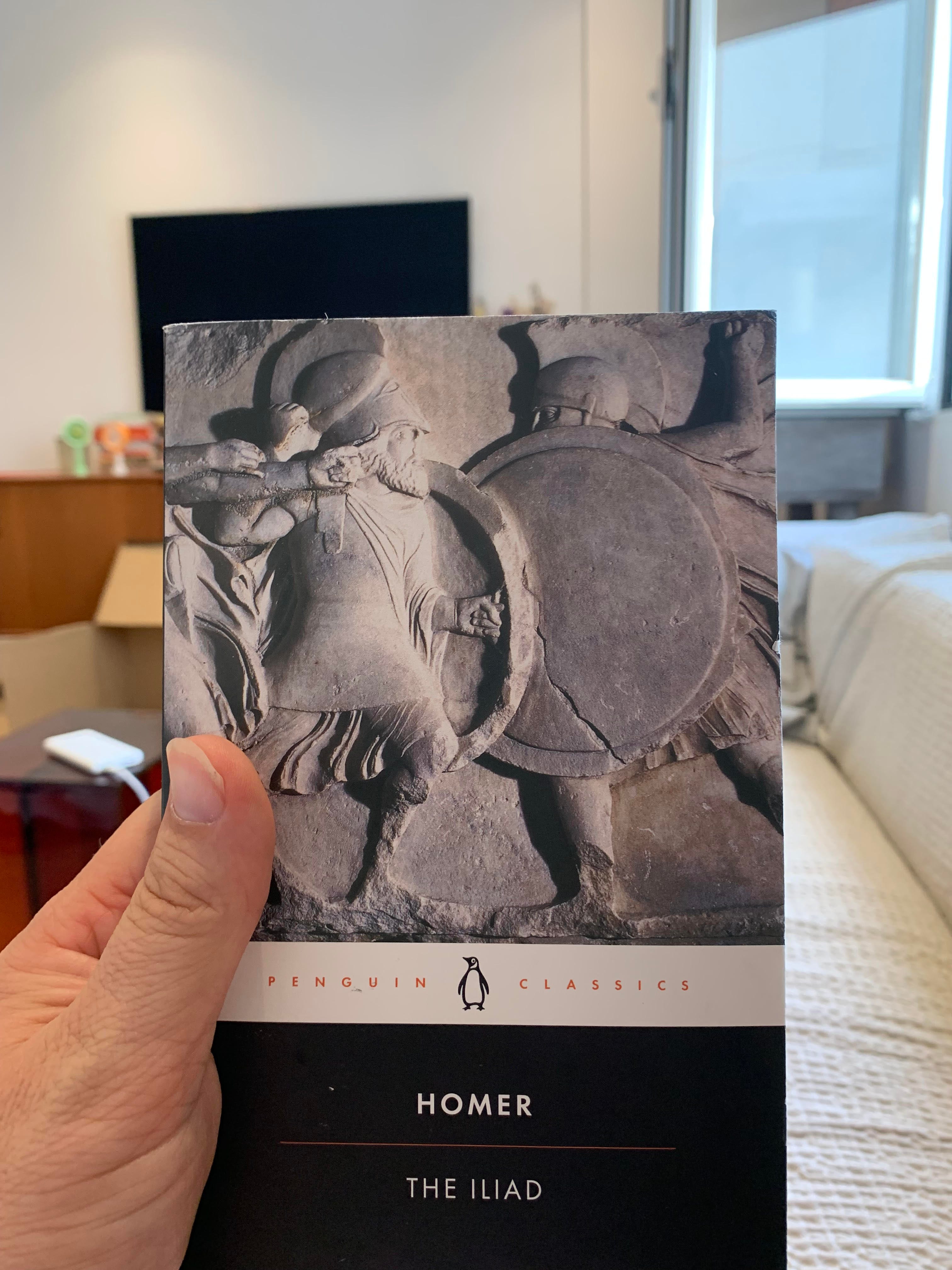
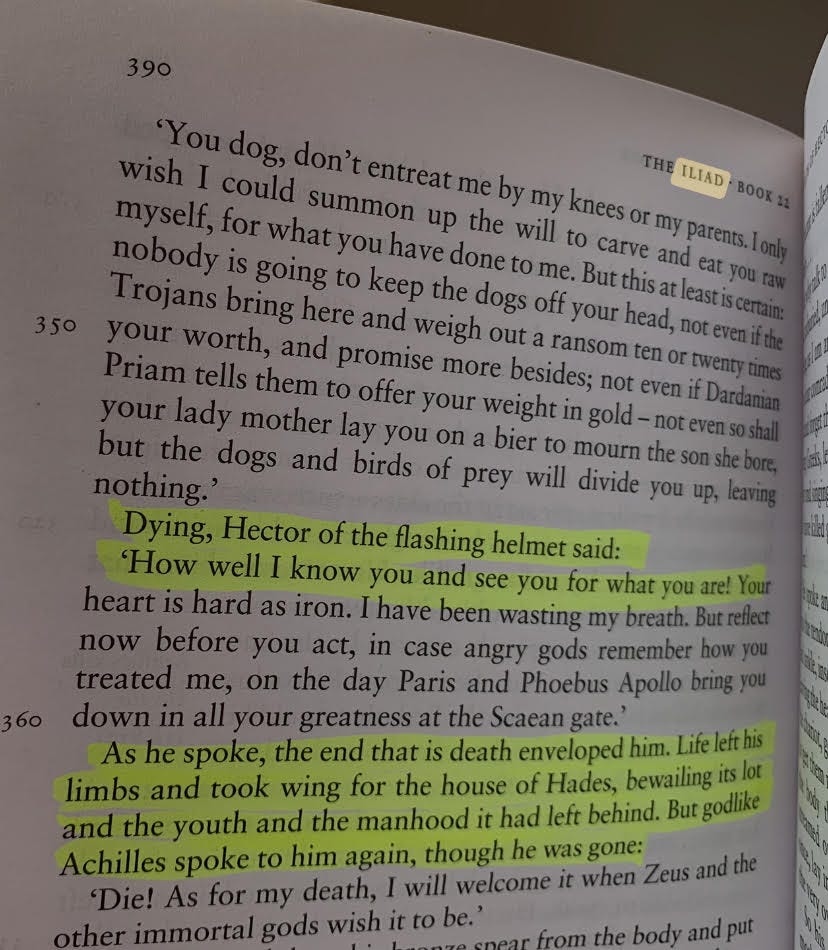
I finished my reread of Homer’s The Iliad. Listened to it via Audible but also bought the same version (Penguin, 1950) in paperback physical copy. The book was about 20-ish hours. Can’t remember when I last read it but I have read it all the way through at least once; ditto The Odyssey, which I’ve read two or three times.
The Iliad, written likely around the 8th century BCE by a classical Grecian named “Homer” who may or may not be one man or multiple people, is writing about the Trojan War which is a likely mythological war possibly based on some real events from centuries prior, perhaps around the 12th century BCE; it was a 10 year war between Troy and the Greeks back in the 12th century BCE, roughly 400 years before Homer. And Homer himself was alive roughly 250-350 years before Socrates and Plato.
How was the read? It’s a fair question given that we’re nearly 3,000 years out from the creation of it at this point. One must also remember that the first written version of The Iliad (The title derives from Ilion, aka Troy) was likely somewhere in the 8th-6th centuries but the earliest surviving written version we have dates from the 10th century AD…far, far after Homer existed. Before that The Iliad—an “epic poem” told in the Greek form of dactylic hexameter—was performed orally by mouth, told to Greek audiences accompanied by the playing of a lyre. Homer himself likely did this kind of oral tradition. Only many, many generations later did people begin to finally put it down on tablets and later paper where it survived and comes to us still today.
The book covers the very end of the decade-long Trojan War, the fight started over a woman—predictable—named Helen. She is Menelaus’s wife but a Trojan named Paris steals her away from the Greeks and keeps her in Troy, where she stays for a decade. The Greeks come and fight for ten years and eventually Troy is sacked. After, one of the main Greek soldiers—Odysseus— takes ten years to make his way home back from Troy to Ithaca, Greece; this is Homer’s second epic poem called, of course, The Odyssey.
The Iliad is basically a whole lot of fighting between Trojans and Greeks on the Trojan’s land. The gods come into play here—Zeus, Athena, Apollo, Hera, etc—who live in Olympus and who basically toy with the Greek mortals in battle down below by helping or hindering either side as they see fit, sometimes changing their mind halfway through. Essentially a game of immoral cosmic chess which the gods play stemming from pride, anger, resentment, favoritism, etc.
There is intriguing complexity: Zeus (king of the gods, son of Kronos) sometimes supports the Trojans but his wife (and sister!) Hera and his powerful daughter, Athena, both support the Greeks. There are instances of lying, treachery and deception. Even the gods themselves fight for and against various sides on the battlefield as well as one another in Olympus.
The central mortal characters are: Hector, Priam, Paris, Aeneas, Helen, Sarpedon, Glaucus, on the Trojan side and on the Greek: Agamemnon (king), Achilles (their strongest and most skilled and most fearsome warrior), Diomedes, Odysseus, Menelaus, the two Ajaxes, Nestor, Patroclus. (And others.) We get constant full battle scenes and also scenes of individual fighting, usually with spears and sometimes swords. The fighting is often gruesomely violent: Eyes knocked out, organs coiling with hot blood and steam out of torsos, bodies being dragged along the earth (Hector’s), etc. Each time one side seems to be winning—such as when the Trojans push back the Greeks all the way to their ships—one or more gods helps the losing side and, like Popeye with his spinach, they push back and are on the offense yet again.
Achilles is crucial. The story was this: Paris stole Helen from the Greeks. As revenge Agamemnon responded by stealing Chryseis from a nearby Trojan town they sacked. But Apollo, a god, wanted Chryseis back or else there’d be hell (or Hades) to pay. So Agamemnon, making a huge mistake, gave her back to Apollo (the Trojans) and as a replacement he stole his best, finest military leader’s prize from war, Briseis, from Achilles. This resulted in Achilles being full of rage and resentment towards Agamemnon and the Greeks. Ergo, though Achilles sailed with his fellow Greeks to the land of Troy to engage in the fighting of the Trojan War…he stayed by the ships and refused to fight. Thus the battle goes on and on seemingly forever.
That is, until Patroclus, one of Achilles’ closest friends, is killed by Hector. All through The Iliad we see Achilles and his stubborn refusal to fight. He is so important of a fighter, though, and he is begged and consulted and seen enough times, that we know as readers he’s the maverick/trump card: At some point he’s going to come into play in the battle. And this works like a sort of tension/suspense literary X factor, part of what draws us into the narrative and need to know how it all turns out. This tension simmers just below the surface throughout.
Finally, Achilles does join the Greeks in the fight and he pushes the Trojans back and eventually does the inevitable: He kills Hector, who is the best warrior of the Trojans. But destiny and fate come into play and Hera, Poseidon (god of the sea and Zeus’s brother) and Athena all push for Achilles. In the end of the book the tide of war has begun once more to favor the Greeks but there is no official resolution. Hector is killed. Priam receives his son’s body. Troy is not shown as falling though it is clearly in danger of doing so.
We never actually witness the final sacking of Troy. Priam—king of Troy and father of Hector—visits Achilles and prostrates himself before the man who killed many of his sons (he had 50) including Hector, his most beloved, and convinces Achilles to return his son’s corpse to him. After that the story ends. We get some flashbacks on the sacking of Troy and the Trojan Horse in the follow-up epic poem, The Odyssey.
The poem is strung through with classic Greek epithets: “Swift-footed Achilles,” and “the longhaired Greeks” and “Zeus Marshaller of the clouds,” and “fast-thinking Odysseus,” etc. For me, some of the hardcore fighting scenes and some of the “winged words” felt sort of tragicomic in ways I’m certain were not meant to be funny back then. But we’re living in very different times now. Still, for being such an ancient story, the symbolism (eagles, lions preying on lambs, the rough sea, etc), the similes and metaphors (accurate, powerful and omnipresent), the use of what we’d today call “cliff-hangers,” foreshadowing, quality dialogue and a moving plot for the most part, even now, in 2026, move the story forward quite nicely.
That’s not to say there aren’t deathly slow parts; for me there very much were. Patches of repetition, patches of the gods just chatting, patches of the moral (and mortal) battlers going back and forth, constant fighting scenes which all started to blur into one. (“His spear was not thrown for nothing,” or “his spear still hungered for flesh.”) But we read The Iliad today not for its brilliant, fast-moving plot filled with tension and conflict (though there is a lot of that) but for its classical and psychological universality, for the mixture of history and Greek myth, so we can understand an ancient culture through the powerful elements of story, to understand ourselves better from a historical Western perspective, so we can, ultimately, see ourselves as a human story stretching far, far back into Father Time.
It’s amazing how so many things don’t change. Ego, rage, fear, lust and desire, fighting over women—Helen, stolen by Paris, starts the whole war—honor, courage, bravery in battle, a desire to return home, the inevitable clash of cultures, ideas, perspectives, traditions, values, the way we see and think about birth, life, death, the symbolism of fire, water, earth, sky, birds in flight, lions seeking prey, etc. The Iliad is the beginning, really, of western literature as we understand it. (Yet it was certainly not the first. Gilgamesh and others came before.) The Greeks believed in the gods before Homer. But Homer’s poems gave humanness, gave clarity, to the gods and to the historio-mythic ideas handed down over the generations. Homer was later revered by the Greeks and was discussed centuries later by Socrates, Plato, Aristotle, etc. Handed down all the way to us, here, now.
Since it originated as an oral tradition I’m glad I listened to it on Audible. It was literally meant to be heard versus physically read. I once thought ‘Hellas’ and the ‘Hellenes” and the “Hellespont” and the “Hellenic Period” were derived from…Helen, the wife of Agamemnon stolen by Paris of Troy. But there’s actually no connection. “Hellas” simply refers to “the Greeks.” The Hellenistic Period referred to the expansionist years wherein the Greeks conquered and spread their colonies and culture all over the world a la Alexander the Great. The Hellespont is a strait of water (the Dardanelles) near Turkey and the Aegean sea.
The ancient Athenian Greek political system of assemblies and direct democracy is not, of course, our modern American system. But the American founders studied antiquity and took many concepts from them. In the ancient times they were free in many ways and yet women still have very few rights, there were slaves bought and sold, some had great wealth and many were poor, many people voted in assemblies, war was normal, as were the Olympic Games, sports, etc. Philosophy as we know it from Socrates on down came later. (Yes, there were pre-Socratic philosophers as well.)
Homer brings us a mirror we can use to see ourselves showing us that as much as things change over literally thousands of years…a shockingly high amount of things fundamentally don’t change. Humans are humans are humans, with their greed and their ego and their desire to grow and conquer and continue technological advance and to understand their own time through art, literature, oral tradition, ceremony, etc.
You might call the Iliad the “first novel,” even though it’s not actually a novel (novels didn’t exist then) but an “epic poem.” Yet it’s not our modern idea of rhyming poetry. It reads like a novel. It has a plot. Tells a story. Has dialogue. Adventures. Action. Exposition, rising action, climax (when Achilles finally joins the battle and kills Hector), resolution, etc. Perhaps it would be more accurate to call it one of the first and surely the most enduring of Western Narratives. If Western literature means anything, it all started with Homer.
Women won't read this. The story is way too macho and maybe only the Helen of Troy scenario interests them. Women do not read action adventure books, nor war movies, nor much anything about soldiers unless it is a woman soldier. As you know, the girls rule. I suggest you read a translation of a famous Albanian author.
Michael - I enjoyed your essay very much. Great authors frequently 'tap the source' - going all the way back to the first published work for inspiration. The game of telephone tells us why: the original is the Eureka!, the most honest, and the least changed. But not necessarily the best. The illiad is too long and too repetitive, but it is such a rich source of original inspiration. If I want to know how Western men think, The Illiad, and even more so, The Odyssey are where I go to find out.