
A Supposedly Fun Thing I’ll Never Do Again (East Africa: Kenya, Tanzania, Zanzibar Post #1)
Actually…I loved it. (And Partially Hated It.)

(*Above video from Ngorongoro Crater)
*Apologies on the delay in posting. It’s been 11 days, by far the longest I’ve ever gone without publishing anything. We’ve been and still are in East Africa and I hadn’t scheduled any posts ahead because I figured I’d write about Africa…but what I didn’t consider was the lack of Wi-Fi and my not having data. Ergo I went close to six days with no internet 80% of the time. Not to mention how early we were getting up and how busy we became.
**I plan to post several Africa essays as the days go on since I’ve been journaling since we arrived, but today I just wanted to give you an overview of the trip broadly as a whole so far.
***A story of mine, one of my most tightly-drawn stories, about working-class white kids in rural Southern California, was just published HERE on Byker Books Books. Please read, share, restack and spread the word! I am proud of this short story. I worked on it for years.
****Main title of this essay taken from David Foster Wallace’s famous, humorous and insightful essay called “A Supposedly Fun Thing I’ll Never Do Again” about going on a cruise.
~
It’s 12:50pm and we’re in Zanzibar, the little island just off the coast of East Africa in the Indian Ocean. We arrived last night (technically this morning) at around 2am after a long, long day on the mainland in Tanzania in East Africa including a short one-hour flight in a small propeller plane from Arusha Mount Kilamanjaro Airport to Zanzibar and then a one-hour drive from a slightly mad young man who drove a little too much like our Hunter S. Thompson driver in Thailand a couple years ago.
It’s hot, low 80s, and humid to the point of being tropical. Our hotel-apartment is small but lovely and is literally right on the sand facing the ocean 100 feet away. We have an outside deck with table, chairs and even a makeshift bed (we also have a small bedroom inside.) In short, minus the staggering humidity, it’s pretty spectacular.
Today is our 10th day in Africa. We left Madrid on January 22nd flying first to Istanbul, Turkey, for a two-hour layover before then flying to Nairobi, Kenya. (East Africa.) This is our second time in Africa; a couple years ago we traveled in Morocco for a couple weeks, where incidentally I got COVID mid-trip and ended up sick and in a public hospital. (Read that essay HERE.)
Nairobi was incredible. We stayed in an Air BnB run by an Indian guy born and raised in Kenya, his father arriving from India many decades back. Mohan is his name, a tall, thick, dark-skinned Indian man, kind, thoughtful, spiritual but not religious, with a thatch of dark hair and a dark thick mustache and glimmering, soft eyes. We almost instantly connected with him and were suddenly sitting at his large, long table on his wide deck overlooking a farm and wilderness, chatting about deep things like politics, religion and death. He talked about how men can legally have four wives and how “The West” has corrupted the youth. While steeped in Eastern values of patriarchy and male dominance, he was nevertheless extremely affable, smart, open-minded (for the most part) and funny.
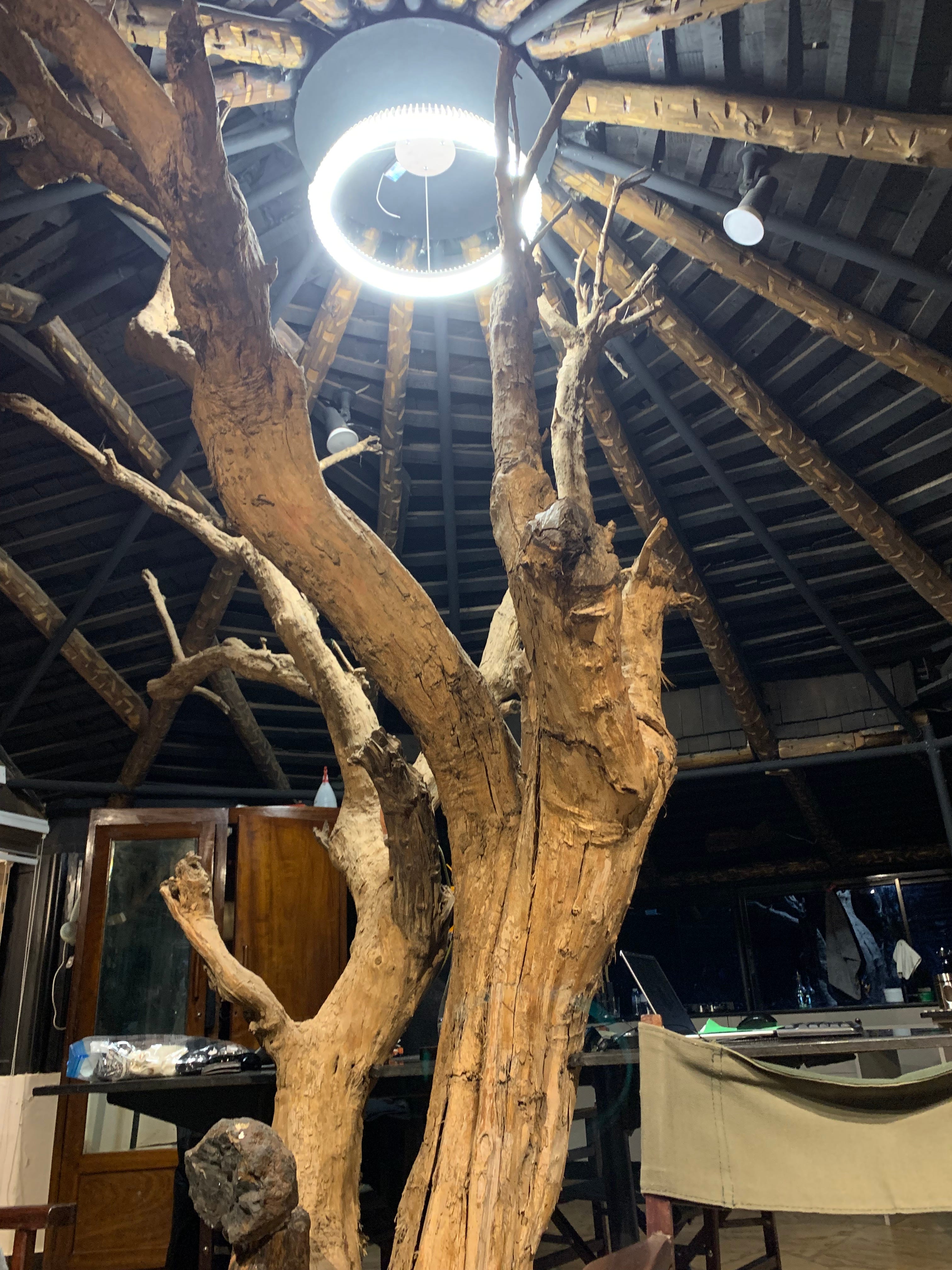
He manages the Air BnB for his nephew. The Air BnB, the “treehouse” is a lovely sort of a giant yurt/hut thing, circular in shape, like a massive tent, with windows all around it (we can see out; they cannot see in, until night), a tree literally in the middle of the thing, a kitchen, couch, sitting space, bed, and shower with a button for minimal hot water. Think of it as “glamping.”
Mohan’s house was large and across the yard. He has a servant, a Nairobian woman who silently does just about everything for him. It was hot here. We were within a “compound” between several gates at various points, a suburban, safe area. He warned us to stay within the compound. One day I ignored this warning and ended up in one of the Nairobian slums, a shantytown full of poverty and crumbling shanties with rusted corrugated tin roofs and kids playing around in the dirt and mud. It felt like parts of Mexico. I felt extremely white, privileged and American. Myriad eyes bore down into me. I turned around and headed back.
It was a fun 5-day visit in northwest Nairobi consisting of Thai food at a local restaurant, walking around the downtown mall and a little around that area, and then, best of all, being taken for the whole day by Mohan (for $150 Euros) out to Limuru, 14 miles outside of the city, passing rolling, gorgeous green hills, fields and valleys, seeing tea and coffee pickers in the tea and coffee fields, getting a delicious lunch at an outside place, an international conference center called Brackenhurst, seeing The Great Rift Valley and driving along the snaking, twisting Limuru-Maimahiu Road which clings along the mountains with a view down below of The Great Rift Valley. Mohan showed us a very old church which we entered. We passed by some other slums. We got dinner at an Indian place which was incredible.
We talked the whole time, about his life and past, about Hinduism and spirituality, about Africa and Kenya and Nairobi, about his wife who lives in India (he has “some girlfriends here and there”) about how his marriage was an arranged one by his mother 45 years ago, etc. He and Britney especially connected. Everyone connects with and likes Britney. I’m usually the more prickly or difficult one.
~
After five days—on I believe January 28th—we were picked up by a driver who would take us to the neighboring country, Tanzania, about six hours to the south…including the time it took when crossing the border. Our driver was a large, dark-skinned, very friendly and interesting 36-year-old Nairobian man with thick long dreads who talked to us the whole drive. We covered many topics, one of which was the “problem” with the Somalis, aka their general arrogance and rudeness and, of course, their Sunni Islamist extremist terrorist group, connected with al-Qaeda, Al-Shabaab. We also discussed Trump and his hardcore immigration policies. He was against the president and his policies in this area, as am I, broadly-speaking. We discussed ICE and Minneapolis, Trump only letting in the white Afrikaners, other African nations, the people and friendly culture of both Kenya and Tanzania, and much more.
The border between Kenya and Tanzania, heading south to Arusha, was interesting. A little slow, a little disorganized, a little confusing. Metal detectors. Multiple desks. Passports, Yellow Fever vaccine cards (we got the Yellow Fever vaccine in Spain along with Hepatitis A meds and Malaria meds which we are still taking now). One line, two lines three lines. Fair number of other people, most of them non-white, non-European. An African woman wearing a hijab blatantly cut in front of us at one point. Britney and I gazed at each other and shrugged. Eh. Not our country. Is what it is. I wasn’t about to start something, be the asshole privileged, clueless American.
It took all told perhaps an hour, not too bad, really, and then we switched drivers and we said goodbye to the former one.
The new driver was nice but less talkative. I mostly let Britney and the driver talk. She likes to engage with them, ask them questions, and it’s easy for me to simply lean back and relax, observing the countryside passing by as we raced along the highway. Outside it was an intriguing mix of desert and forest, mountains in the distance, empty fields and jungle. Poverty was everywhere as we passed through little villages and small towns. Seventy-percent of the locals were thrumming around on motorcycles. Dust rose up constantly. Small unpaved dirt roads running off the highway like dirt veins moving towards the heart of something mysterious and strange.
Eventually we ended up at our hotel, which was not really a hotel but more like a tiny set of half a dozen small rooms and a little restaurant, all of it behind tall thick walls with rolling barbed wire rising off the top like knives at your tender throat. Unpaved dirt roads, bumpy and sketchy, had led off the highway to our abode. The place was lovely and the food was great and we were virtually the only guests there, but it took them positively forever to make the food and to get us caffeine in the morning. Already, due to exhaustion, no desk, and the time to get picked up in the morning, I was not able to write and wasn’t reading much, never a good thing for me. And I had no data, thus no internet. (This ended up being both very frustrating and probably for the best.)
~
The next morning at 8:30—disgustingly early for me and Britney—we were picked up by our Safari guide, a Tanzanian Black man named Lucas. He was my height (short, 5’8), a close-cropped essentially bald head, black eyes which radiated excitement and kindness, a voice which sounded sort of silvery and glittery somehow, as if it contained some small gilt of magic about it. A voice not deep yet not exactly high but closer to the latter. He was 43 (my age exactly) but looked closer to 50. Married, two kids 11 and 7, of the Maasai tribe (his great-grandfather lived in The Bush), he spoke way too fast and with too much energy and had a wide, easy smile and liked to gesture and laugh. His English speaking and understanding were above average but we still struggled sometimes to understand him and had to ask him to repeat himself often. Especially Britney. He spoke to B, she looked confused, and I translated his English. My first impression was, Fuck. Because I hadn’t considered the Safari as being something akin to river-rafting, where the guides are constantly trying to sell you on the experience, trying to get your money, and trying to entertain you, the “rich” Americans. (Here Britney would want me to interject and say that we are NOT rich, and by American standards this is true…but not by African.)
We sat in Lucas’s gigantic tan Land Cruiser especially used and designed for safaris, the ones you’ve probably seen in ads for just this adventure. There was a roof which opened up, a metal bar giving us handles to deal with rough off-roading, a massive cooler in the back with water bottles. The thing was long, fitting seven people, but we’d (Britney, let’s be honest; she is the Head Planner) “accidently” signed up for a private tour (which explained the higher cost than we’d expected) which meant that for the next four days it would be just me, Britney and Lucas.
We drove again further south ending up at Tarangire National Park, where we ate lunch, peed, re-upped on water and then entered in the Cruiser hoping to see some animals. After a night of shitty sleep and not enough caffeine, and too much socializing (the irony of me is that I love travel and I love people…and I also love routine and hate human beings), not to mention that I’d had to go #2 since waking up but hadn’t had time (I take a while), I was exhausted already and kind of over it all for the day.
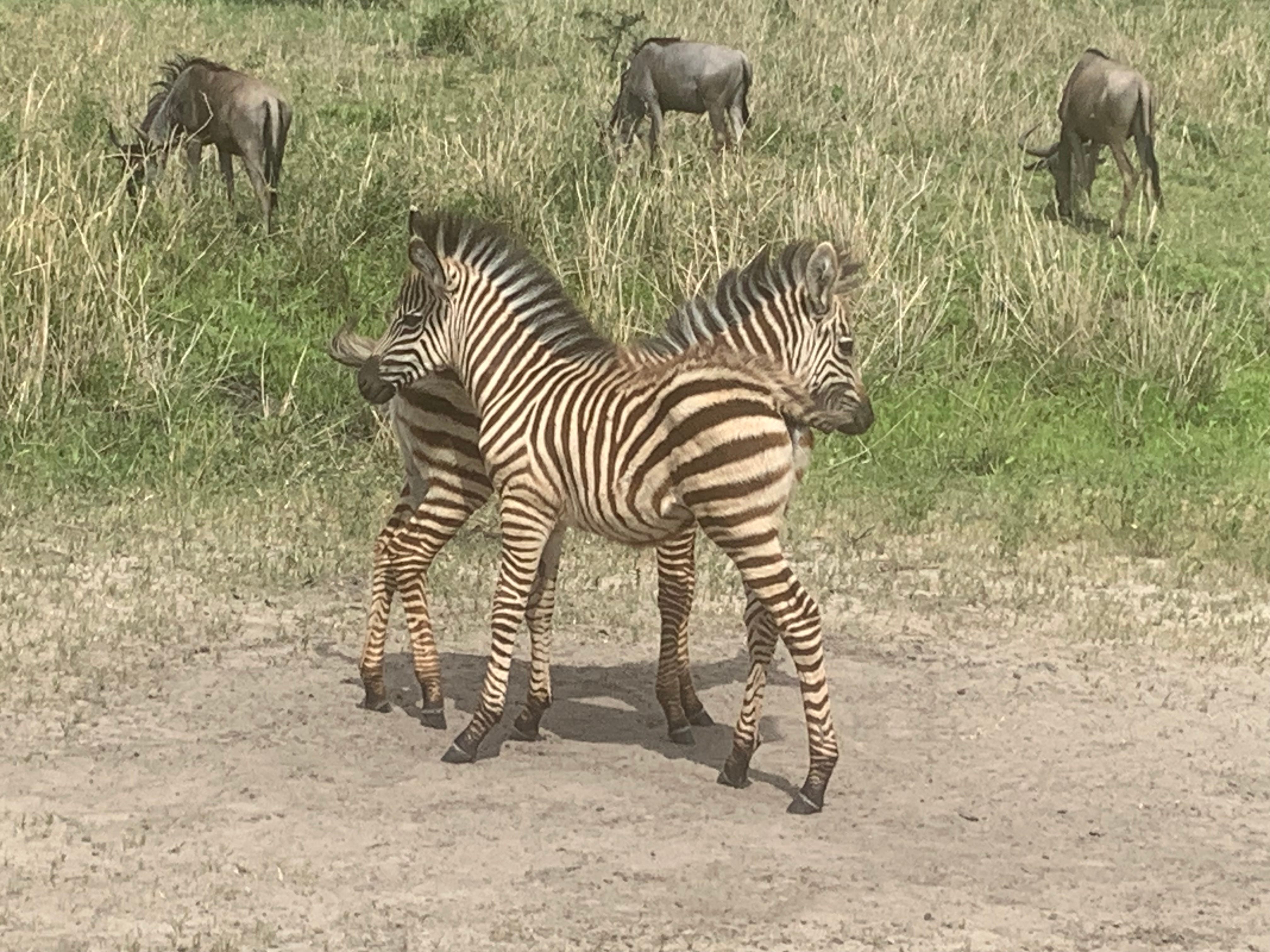
That is, until we saw elephants, and then baboons with their young, wildebeests everywhere, Zebras in their shocking contrast of white and black striped colors…and then a young male lion whom we got within five feet from at several angles. We watched the lion prepare for a kill of a wildebeest, the lion under the shade of a tree, but each time he decided against it and, lazy bastard that he was, he laid down again and slept. Evidently most of the animals in the wild more or less seem to follow this protocol, especially in the summer. (It is their summer now.) But it was a surreal, magisterial experience. It shocked me into full wakefulness, alertness and gratitude. We didn’t get to our next hotel until after 7pm that evening. A long, tiring, but beautiful and unusual day. I kept looking around and thinking, I’m in Africa: This is insane.
I wrote some journals so I won’t go into a ton of detail beyond that, but I’ll relate it broadly.
For three more days we were like pilgrims seeking new land. No clothes were washed. We didn’t have access or, if we did, we didn’t have time. We usually left early and arrived back fairly late. Lucas drove us all over between Arusha and Ngorongoro National Park and the ultra-famous Serengeti National Park, a distance of about 70 miles running north-south with Serengeti in the north, all of it in Tanzania. This included some highways and normal roads but also narrow, steep dirt roads up and down mountains and above the Ngorongoro Crater, which we would explore on our last safari day. Britney was shockingly calm, for the most part, as Lucas drove like a pro, expertly passing trucks and other tan safari cruisers sketchily along the narrow uneven dirt roads. He and Britney had especially developed a rapport. We plied him with questions about Tanzania, the parks, animals, his wife and kids, the locals, the Maasai tribes, etc.
Despite taking a shower every night, I stunk. I’d worn the same jeans and the same shirt and the same boxers for several days by now. My clothes were rimmed with red dust. Mars Dust, I called it. It flew everywhere. Inescapable. I wore my wide-brimmed hat and shades, my thin blue long-sleeved cotton shirt to protect from the sun, and sunscreen on my bulbous, veiny hands. We saw it all: Cheetahs, lions, leopards, hyenas, giraffes, hippos, crocodiles, jackals, etc. It was stunning and magical, out of this world. We couldn’t believe how close the lions and cheetahs allowed us to be, sometimes within four or five feet. We saw them playing like giant house cats under trees, splayed out in open fields, walking along our car.
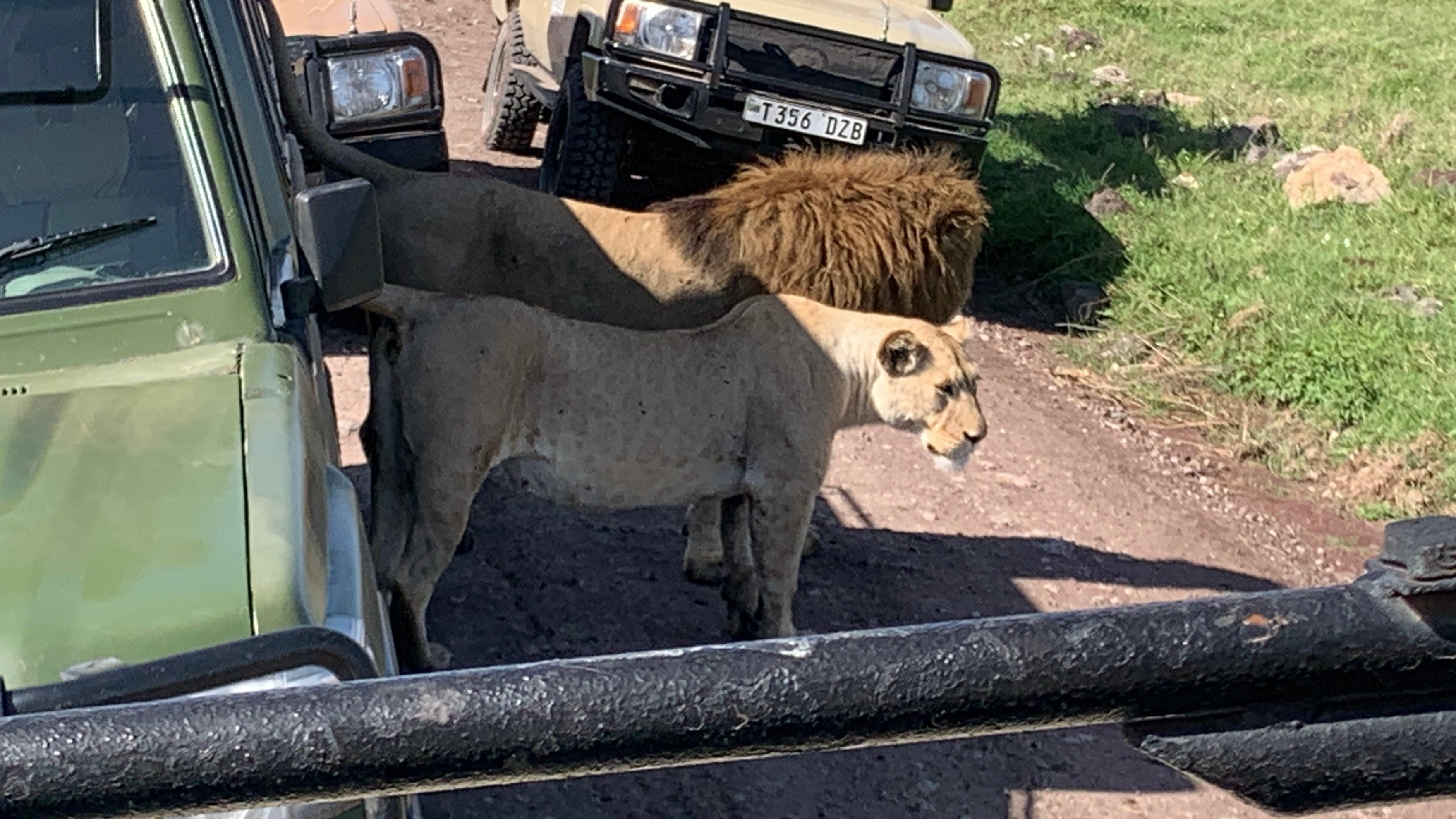
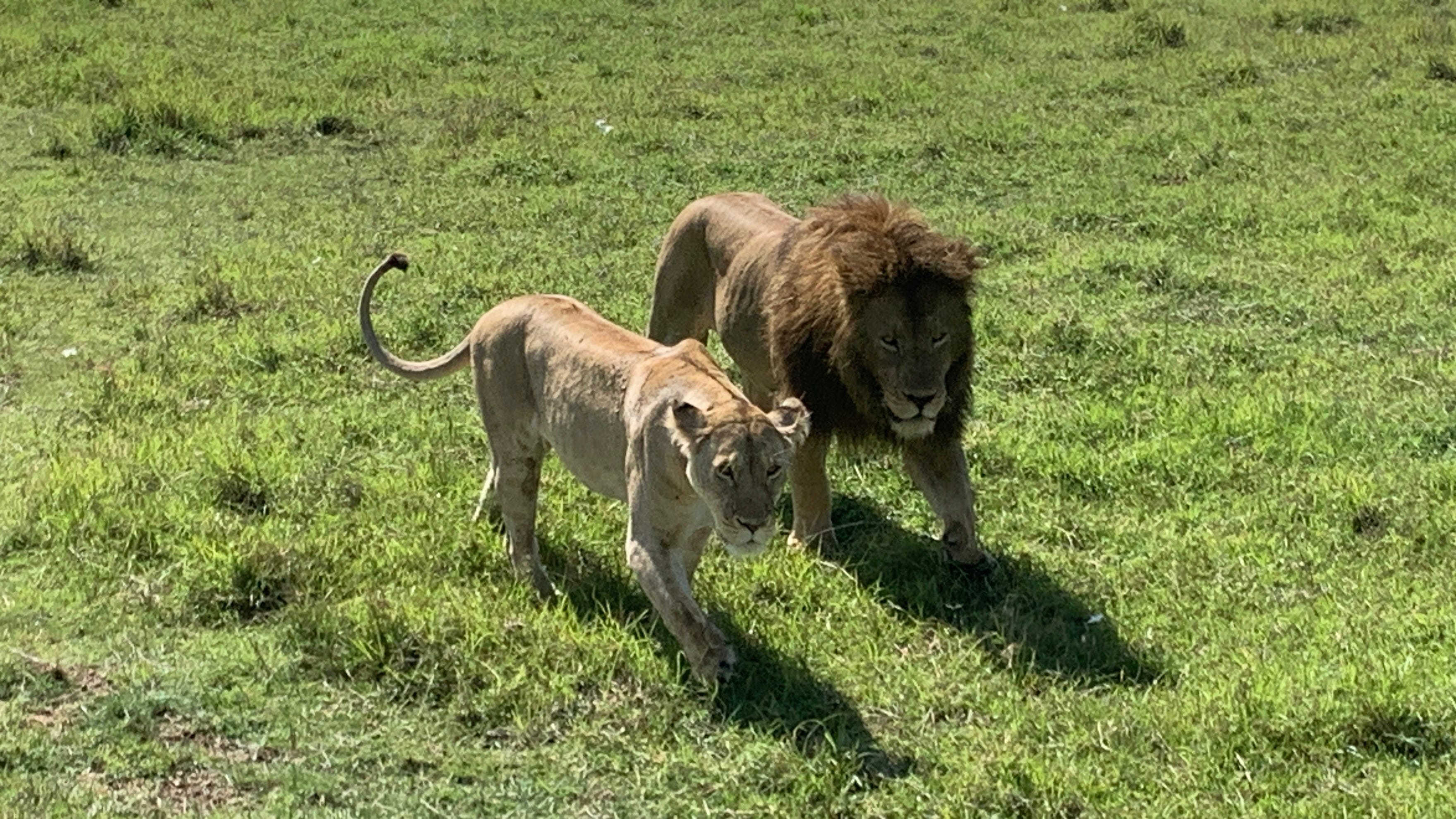
The best was our final day inside the Ngorongoro Crater, which we drove down into and, after two hours, out of going a different way. A male lion with his proud mane and a female strode around along the myriad tan Land Cruiser safari cars, and we all snapped photos and videos and watched in awe and wonder. It was totally unbelievable to see these creatures up close and personal, at one point close enough for me to reach out my window and touch…which I of course did not do because I value my life. (We were never allowed to exit the vehicle inside the parks.) We saw herds of fleeing wildebeests, packs of running Zebras, herds of feral and massive elephants, all in the wild, in their natural environment. There is truly nothing like it.
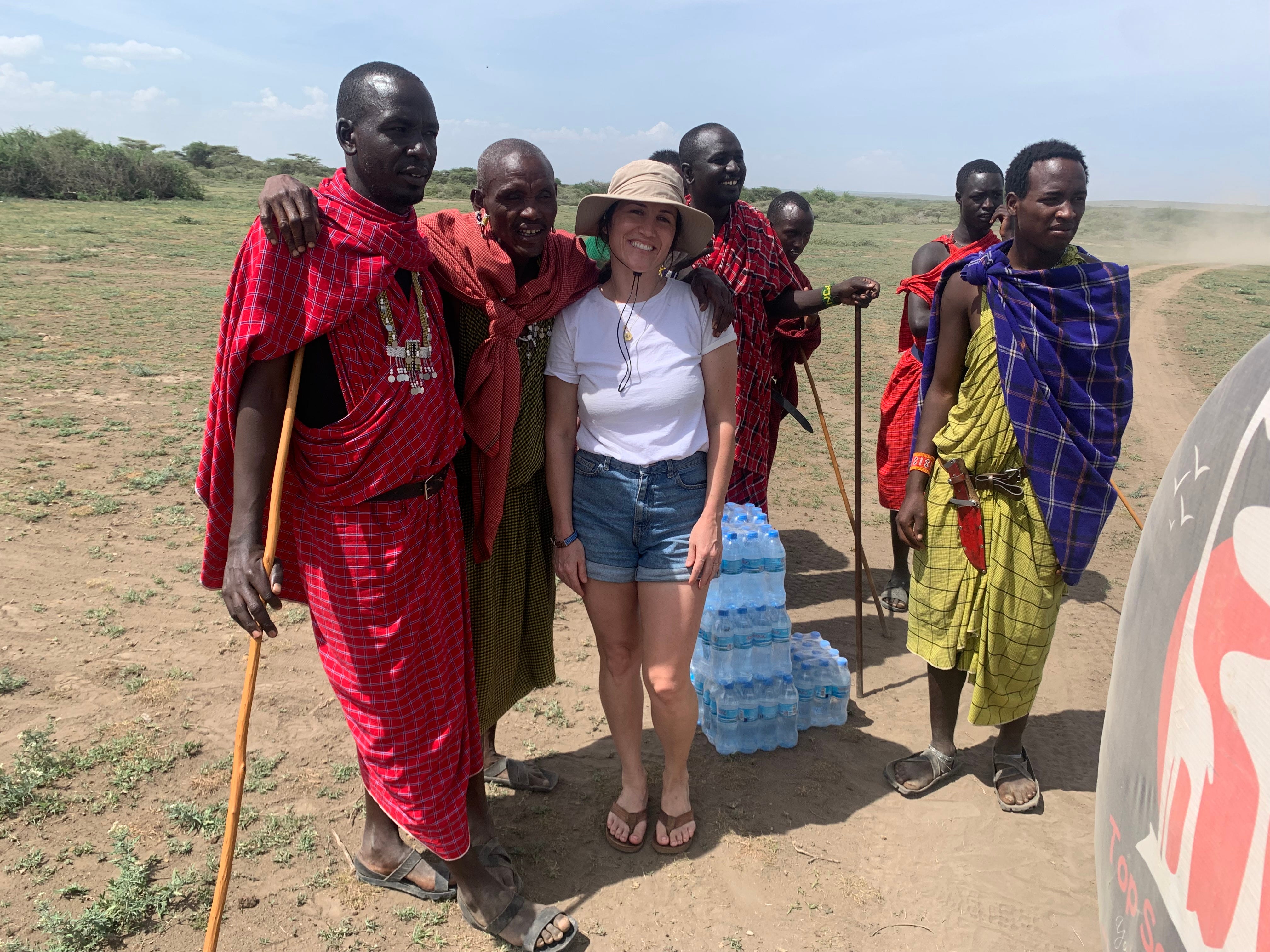
*(Above photo: Britney handing out water to Maasai tribe)
~
By our last safari day, January 31st, when we got up at 5:45am and were in the back seats of the Cruiser, Lucas driving along the highway back to Ngorongoro at 7:30am, along the twisting mountain dirt roads heading towards the crater, we knew we faced a long day. A few hours of safari, then back to Arusha Mount Kilimanjaro Airport, several hours’ drive, where we had a late flight at 11:30pm the one hour to Zanzibar. After the crater, where we saw lions walking along our car for quite a while—and saw our one and only distant rhino—we slowly took our time driving back towards Arusha, talking intermittently with Lucas. We stopped for lunch. We stopped at a Tanzanite gem store. We stopped at a tourist trap and bought T-shirts. We stopped to buy red bananas.
This was one aspect I didn’t love and yet of course I understand it: As tourists, and especially as Americans, the locals are always friendly, smiling and kind…but they also see you as more or less one major symbol: A big, fat dollar sign. I get it. It’s a poor country. It’s a mostly, generally poor third-world continent. They need and crave our money. Roughly 2,580 African “shillings” (a vestige of colonial Britain, the empire that once owned a quarter of the globe) equals $20 USD. Many live in tiny shanties with corrugated roofs. In some areas water is short in supply. Not unlike parts of Mexico, at least as far as the general poverty. The police generally seemed nice and friendly but we were told they are fairly corrupt. Not shocking. Money greases the wheels, just like every other aspect of life. Lucas, a guide for 12 years now, seemed to know everyone. Each time we stopped for coffee and tea, a bathroom, etc, Britney and I’d come back to the Cruiser and he’d be gone, emerging from somewhere fifteen minutes later laughing with someone.
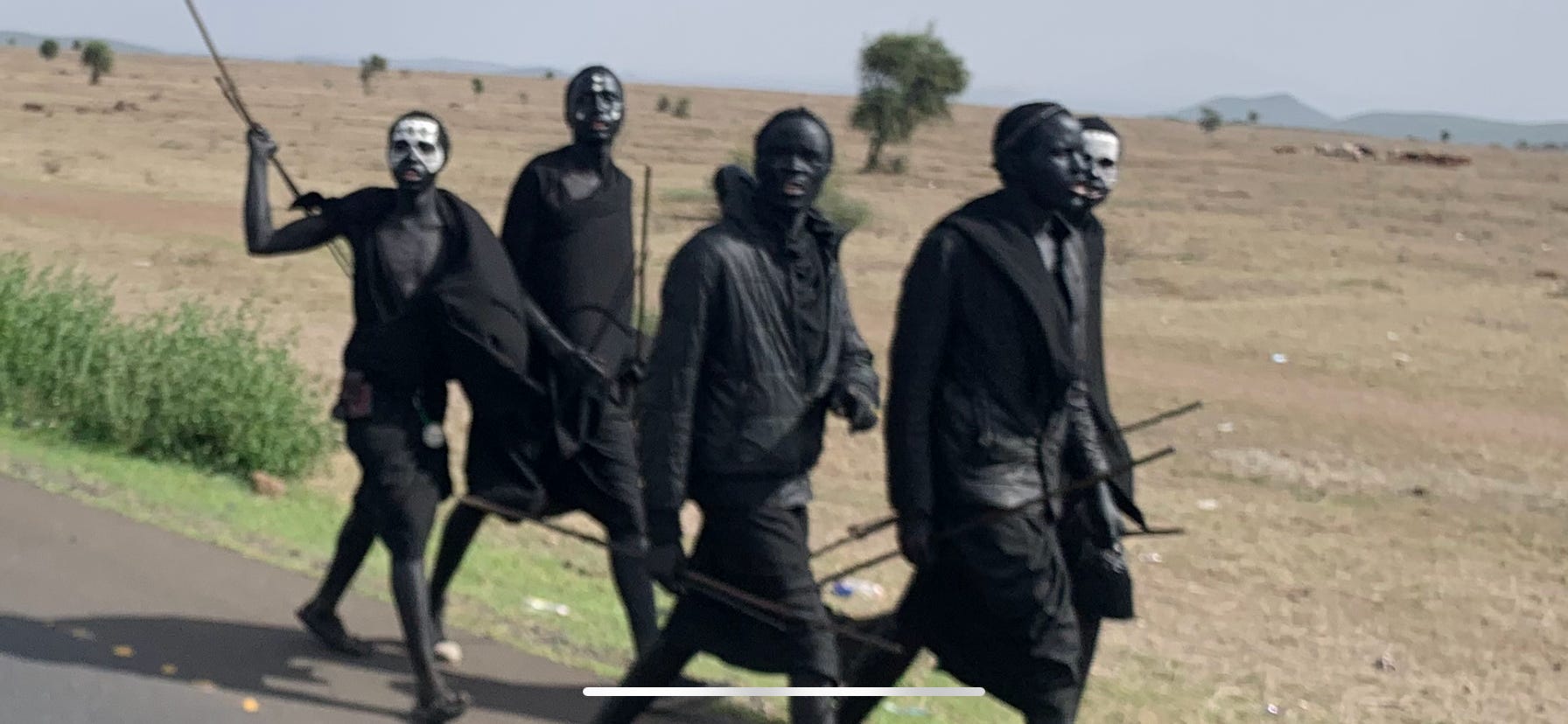
A couple days before the safari ended, Britney, with her big heart and kind soul, decided we should spend $100 USD on as much water as we could get and hand-deliver it to the thirsty Maasai tribes who lived in primitive thatched huts along the roads between the parks and who started fire by literally rubbing two sticks together. We’d actually stopped at one tribe before the water project and had danced and sung with them and then been shown their farm and huts, their “school” which was a wooden shanty, and their animals. They stunk a little bit but were very kind. We did, of course, have to pay them, something around $40 USD. (A lot of shillings.) It was a special if weird experience.
All of these interactions felt both authentic and artificial, including our experience with Lucas. The truth was that we were American tourists, aka money, and we understood implicitly that all our interactions were driven, greased, oiled by United States dollars in the form of shillings. To see and interact with the Maasai tribe, we had to pay. Every time we stopped somewhere kids ran up like flies on a corpse and asked for money. Honey-maker Maasai tribes assaulted our windows trying desperately to sell us honey they made. Grown men tried to sell us bracelets and various wares. Tipping was expected everywhere. Lucas, God bless the man, mentioned tipping and reviews multiple times. We often gave a little bit but when we didn’t they were disappointed, a few times borderline angry. I’ve never been a fan of fake friends in exchange for money. I’m as a real, as authentic a guy as you can get. But I knew the reality of Africa, and the reality of how they viewed us from their vantage point. We came from the USA, where resources abounded and everyone was “rich.” And they weren’t wrong.
~
So we bought, for $113 total, about 35-40 cases of water bottles and as we drove between the parks and our hotels (we stayed in a different one each night) we pulled off the dirt roads into the tribal huts and gave out water. I filmed Britney handing out water at one point. She hated being filmed and didn’t want to be but I couldn’t resist. She was adamant about not doing this for clicks or likes (she has not and will not post about it on social media, though I did on mine) and was instead truly for the people.
Especially the hungry and thirsty Maasai kids broke her heart. These kids, some as young as four, herded goats, sheep and cows so thin their ribs poked out, along the desert shrubs off the highways. They always smiled and waved when we yelled JAMBO out the windows, Swahili (the continental-wide common language amongst all Africans no matter what country) which means “hi.” We waved and shouted and they shouted and waved back. We pulled over and gave some of these kids cases of water as well. And we did return to the very tribe where we’d paid and danced and gave them many cases. Some of them chugged immediately. These were people wearing cloth robes and very simple self-made sandals, who ate their own animals and lived in tiny thatched huts like early agricultural man 10,000 years ago.
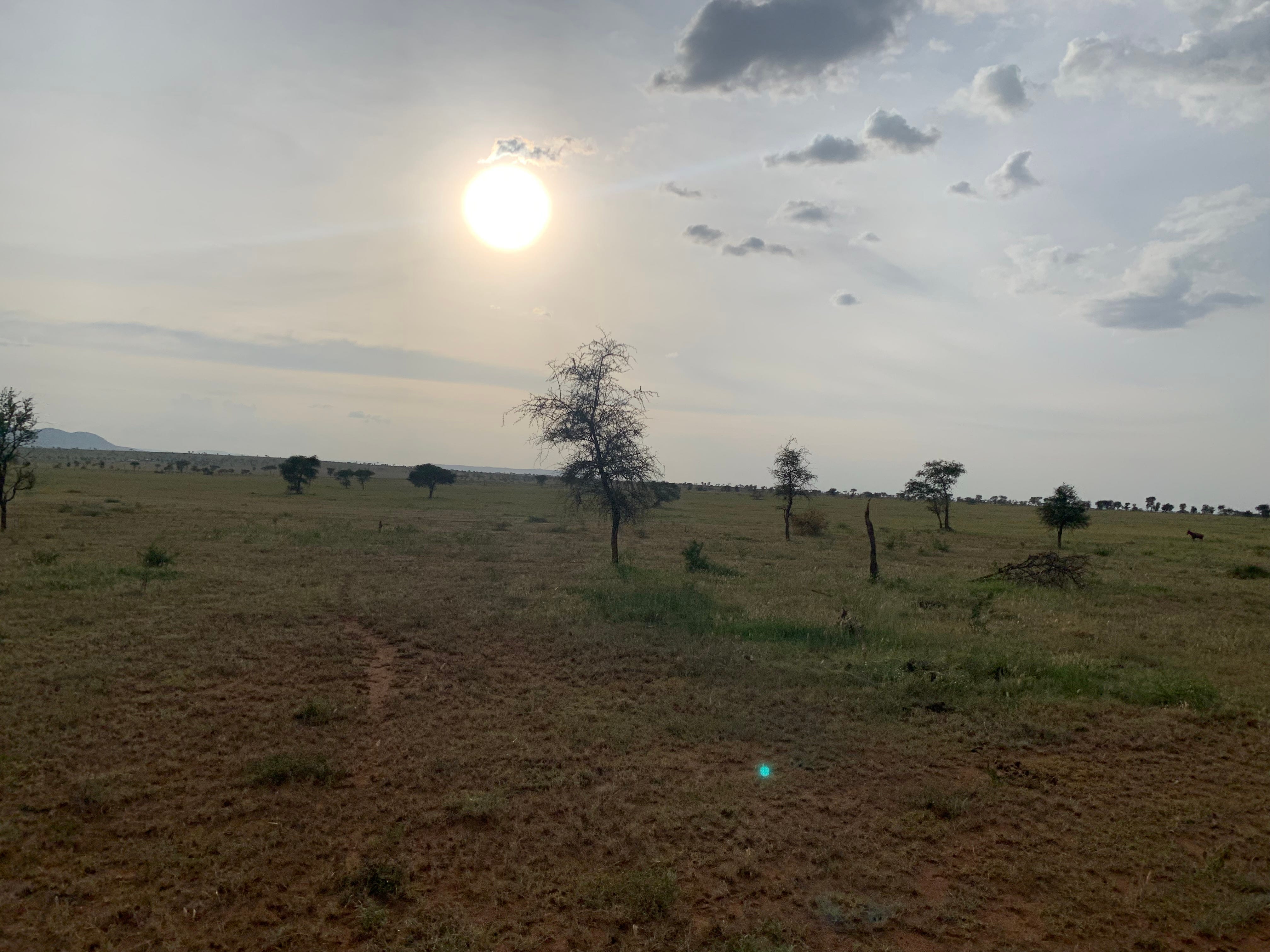
There was desert and dry brush, wilderness in some areas, jungle and rainforest and distant blue and purple mountains. Some of it reminded me of various parts of California, Yosemite, the Mojave, the thick forests up in Mendocino County, etc. We were filthy and stinky, tired and ready to move on. Lucas finally got us back to the coffee shop where we’d first stopped after he picked us up the first day. We ate and relaxed and had tea and then another driver picked us up and took us to the airport. (It was sad saying goodbye to Lucas. We’d genuinely connected with him. We got to know him and he us. He invited us to stay with him in his home anytime if we came back, which we already want to do. He said the most difficult safari clients were the Brits, the Italians, the French and the Chinese. Americans were beloved, he explained, because they give the biggest tips. Eyeroll. Like I said, I didn’t love the sensation of everything being transactional. It felt a little dirty, sometimes a lot dirty. But it’s just the way it is. It was still a genuine experience, even if the tourist machine was greased by cash. That said, we won’t be doing this again very soon, because in actuality we are NOT rich by USA standards.)
At the airport we waited patiently in the small place for the counter to open to Tanzania Air and then we checked in and did two rounds of metal detector security checks before at last boarding the plane and taking the loud, whirring, one-hour small-plane flight to Zanzibar. We got in last night around 12:30am. (This “morning.”) By the time we did the one hour drive, met with the security guy, were told about the place, and I’d showered and we were in bed, it was 2:30am. By 3am we’d passed out.
I woke up this morning and walked out to the main living room area and saw the sea, the Indian Ocean, the tide extremely low, a random boat or two lazing on the beach. Sand stretched left and right for a long while. It was quiet, the slow, lazy, rhythmic sound of crashing waves along the beach the only noise. Also it was hot and tropically humid. It’s got that climate; we’re northwest of Madagascar, the much bigger island. I ordered us food and coffee and tea and when they didn’t come I walked down the three flights of stairs and spoke with a woman on staff and she said there’d been a mistake and we had to move to the room on the floor level. I ordered us food and coffee/tea and we packed up all our stuff we’d pulled out last night and went into the new room downstairs, literally on the sand. They brought the food and caffeine and Britney and I sat outside on the little deck at the table and ate, sipped and watched the flat sea in its low tide. Glorious.
We only slept from roughly 3 to 8am. But that’s ok. We’ll sleep tonight. After we ate I worked on Blood Meridian (reading it), happy that I am close to the end at last. (Expect a review essay.) B cleaned and showered and did her routine as much as she could. Already sweat was beading down my face into my scraggly beard. I feel a bit like an old tribal leader, old and wise in my ways, and yet set in my traditions and ways. I have been complaining more so far on this trip than usual. Britney never complains when we travel. She’s like some kind of freakish angel. She always smiles and shrugs and takes it in kind. I get angry and frustrated when the unexpected happens, and of course the unexpected always does happen when you travel as often as we do. But I can also laugh at myself.
We are damn lucky, to be alive, to be sober, to be traveling in Africa, living abroad in Spain, doing things our way on our terms.
We stay in this same room (thank God no more moving locations every day) in Zanzibar for one week, and then it’s a small-plane flight to Nairobi, and the following day the Big Flight to Istanbul and then finally one more plane home to Madrid.
As they say out here, Hakuna Matata (“no problem”). Those are words to aspire to.
It sounds like the experience of a lifetime. Absolutely wonderful people in Africa. Yes it’s transactional. You give the money, they give us experience we could never have.
I just finished reading the verbal painting you posted. I'm so very happy to see that you and B are literally living life to its fullest. AWESOME! ENJOY IT! It's hard to believe that it's been almost a year since you moved to Madrid. I sincerely hope that you've been able to extend your time abroad. If the humidity is getting to you, as of this writing, here in NYC, the temperature is 12 above zero and with the windchill it's a balmy 0 degrees lol! Get in touch when you can. Much to catch up on.
Rick